In a previous article (here), I discussed how exploring multi-lingual text data on qdrant's UI lead to the following discoveries (1) a heuristic that uses the count of characters associated with a specific language achieved performance comparable (if not better) to nomic-embed-text-v2-moe:latest and gemini-embedding-001 in identifying the language in the text - both LLM’s support multiple languages (2) nomic-embed-text:latest which only supports English language achieved comparable performance to gemini-embedding-001 in the language identification task. The languages used in the task can be further grouped into their respective proto-languages - the so called primordial language from which a set of languages evolved. For instance, Amharic, Arabic, Hausa, and Somali are postulated to share a common ancestor (mother lanugage) termed Afro-Asiatic, while Tamil, Spanish and English belong to the Dravidian language group. This led to the following questions:
Could word representations be used in proto-language identification?
Which of the LLMs is best suited to identfying the proto languages of the text?
Key Findings - Good for the gander: the embedding models identified the proto-language (language group) of the text roughly as well as they identified the language itself (see here). - Broad language support did not help:nomic-embed-text-v2-moe:latest, which supports almost every language in the study, had the lowest mutual information and recall. - Small language groups are the hardest: performance was weakest for language groups made up of one or two languages, e.g. Turkic and Kra-Dai (Thai).
So What - Language identification could potentially be split into a two-step process consisting of first identifying the proto-language (language group) and then identifying the specific language. - gemini-embedding-001 is also better at retrieving translations of the same verse across languages (here), so a single model could serve both semantic search and language-group identification.
To address the two questions (above), I adopted the following approach:
Word embeddings and their corresponding text and attributes were sampled from three collections on qdrant where each collection corresponds to vectors produced using either gemini-embedding-001, nomic-embed-text-latest, or nomic-embed-text-v2-moe:latest. The text consists of quranic script in a variety of languages obtained from tanzil.net. Details of the text data and the LLMs is provided in Section 2.0.
To enable like-for-like comparison between the vectors, samples were first collected from one collection and the text from the collection was used to obtain a matching sample for each of the other collections i.e. the only thing that differs between the three collections is their word vectors (word embeddings).
For each sample from the collections, a UMAP model was fitted on a subset of the sample i.e. the training set, obtaining a projection of the data on a 2-dimensional Riemannian manifold. PCA was first used to reduce the dimensions of the vectors before fitting the UMAP model. Subsequently a knn-classifier is fitted on the projected data, assigning a label (predicted language group) to each record. This is similar to the BERTopic approach.
flowchart TB

A[word embeddings] -->|sampling| B[sample]
B -->|UMAP - Dimensionality Reduction| C[Projections]
C --> |KNN Classification| E[Language Classification]
E-->|Metrics Calculation|F[Comparison]
2.0 Data
The vectorised quranic text obtained from tanzil.net is stored in the following collections on a qdrant instance running locally on a homelab cluster. Details of each collection and the vectorisers used is provided below:
A list of the languages covered in this study and whether or not they are supported by either of the embedding models is provided below
Code
Language
gemini-embedding-001
nomic v1.5 (nomic-embed-text-latest)
nomic-embed-text-v2-moe
am
Amharic
✓
✗
✓
ar
Arabic
✓
✗
✓
bs
Bosnian
✓
✗
✓
dv
Divehi
✓
✗
✗
en
English
✓
✓
✓
es
Spanish
✓
✗
✓
fa
Persian
✓
✗
✓
ha
Hausa
✓
✗
✓
nl
Dutch
✓
✗
✓
ru
Russian
✓
✗
✓
sd
Sindhi
✓
✗
✗
so
Somali
✓
✗
✓
sq
Albanian
✓
✗
✓
ta
Tamil
✓
✗
✓
tg
Tajik
✓
✗
✓
th
Thai
✓
✗
✓
tr
Turkish
✓
✗
✓
ur
Urdu
✓
✗
✓
uz
Uzbek
✓
✗
✓
zh
Chinese
✓
✗
✓
2.1 Sampling
Samples were collected from the collections starting with one collection first and then using the text in the first collection to sample records matching the same text from the other two collections.
The data is largely comprised of text in English (en) therefore some downsampling was applied to prevent skewing the results.
Code
def downsample_majority(df,samp_col="language",random_state=1235813): props = df.groupby([samp_col]).size().to_dict() sorted_props =sorted(props, key=lambda e:props[e],reverse=True) maj = sorted_props[0] avg_minority =int(np.ceil(np.mean([props[e] for e in props if e!=maj]))) A = df[df[samp_col].eq(maj)].sample(avg_minority, random_state=random_state) B = df[~df[samp_col].eq(maj)] C = pd.concat([A,B]).reset_index(drop=True)return C
An example of attributes of vectors sampled from the collection corresponding to gemini-embedding-001 is shown below. The column text in the table is what the vectors were generated from.
Code
samples[init].head()
index
id
language
name
chapter
verse
text
surah_name
revelation_order
revelation_type
revelation_note
language_description
language_group
0
236019
f2627bd6-f23a-54e5-a1a6-5bbdbad95756
en
ahmedraza
88
7
Which neither give strength nor satisfy the hu...
Al-Ghaashiya
68
Meccan
NaN
English
Indo-European
1
248871
ff6d1d6b-bf5d-52c7-962a-966cc590144a
en
qarai
68
26
But when they saw it, they said, ‘We have inde...
Al-Qalam
2
Medinan
Except 17-33 and 48-50, from Medina
English
Indo-European
2
217314
df0c4ee7-8643-57f8-86ad-e5c489867bed
en
sahih
10
77
Moses said, "Do you say [thus] about the truth...
Yunus
51
Meccan
Except 40, 94, 95, 96, from Medina
English
Indo-European
3
4029
042bb1ea-609d-5059-bacc-dd2fe3110639
en
qaribullah
37
63
We have made this (tree) a trial for the evild...
As-Saaffaat
56
Meccan
NaN
English
Indo-European
4
24268
18e67fb4-1203-54f0-bf46-d011a8464c28
en
sahih
6
95
Indeed, Allah is the cleaver of grain and date...
Al-An'aam
55
Meccan
Except 20, 23, 91, 93, 114, 151, 152, 153, fro...
English
Indo-European
A sample equivalent to that collected from quran-embedding-prefect-gemini-embedding-001 was collected from the other two collections detailed in Section 2.0
Code
filter_columns = ['language','name','chapter','verse','text']colls = [coll for coll in collections if coll !=init]for c in colls:if collections[c]!=None:print("Processing {}".format(c)) matching_records = fetch_records_for_dataframe( samples[init], collections[c], filter_cols = filter_columns, batch_size =200, with_vectors =True ) samp, vec = extract_payload(matching_records, exclude=[]) samples[c] = pd.DataFrame(samp) vectors[c] = vecassertlen(samples[c]) ==len(samples[init]), (f"{c}: expected {len(samples[init])} matching records, got {len(samples[c])} ""- some rows had no exact match, so the like-for-like comparison ""across collections no longer holds." )else: samples[c] =None vectors[c] =None
An example of attributes of sample records stored in quran-embedding-prefect-nomic-embed-text-latest is shown below
Code
samples['nomic-embed-text:latest'].head()
id
language
name
chapter
verse
text
surah_name
revelation_order
revelation_type
revelation_note
0
f2627bd6-f23a-54e5-a1a6-5bbdbad95756
en
ahmedraza
88
7
Which neither give strength nor satisfy the hu...
Al-Ghaashiya
68
Meccan
NaN
1
ff6d1d6b-bf5d-52c7-962a-966cc590144a
en
qarai
68
26
But when they saw it, they said, ‘We have inde...
Al-Qalam
2
Medinan
Except 17-33 and 48-50, from Medina
2
df0c4ee7-8643-57f8-86ad-e5c489867bed
en
sahih
10
77
Moses said, "Do you say [thus] about the truth...
Yunus
51
Meccan
Except 40, 94, 95, 96, from Medina
3
042bb1ea-609d-5059-bacc-dd2fe3110639
en
qaribullah
37
63
We have made this (tree) a trial for the evild...
As-Saaffaat
56
Meccan
NaN
4
18e67fb4-1203-54f0-bf46-d011a8464c28
en
sahih
6
95
Indeed, Allah is the cleaver of grain and date...
Al-An'aam
55
Meccan
Except 20, 23, 91, 93, 114, 151, 152, 153, fro...
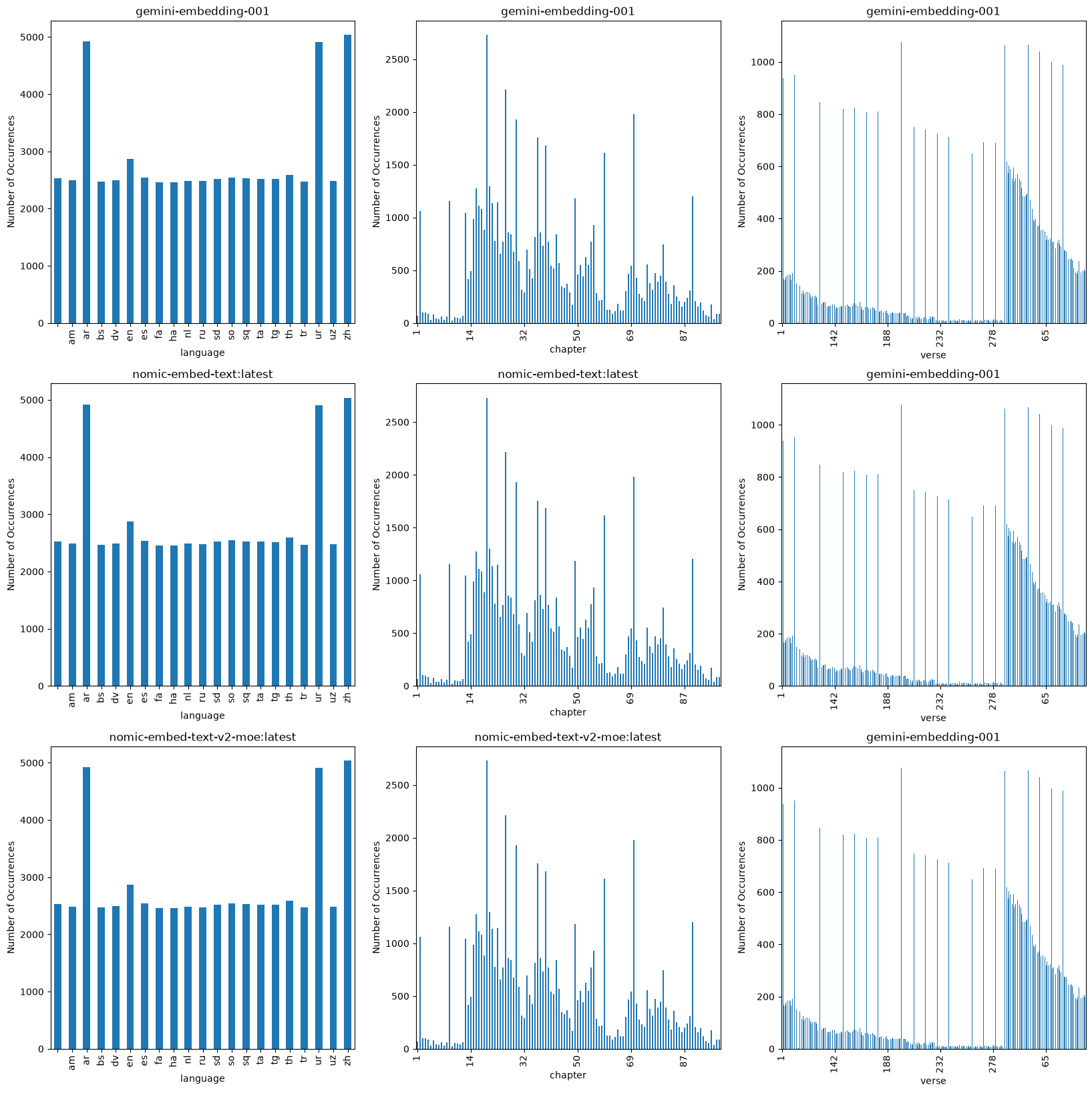
A comparison of the statistical signature of the sample from the collection associated with gemini-embedding-001 to collections associated with the other models is shown below. The figure shows that the samples are equivalent i.e. the text, chapter, and verse match across the three samples.
Code
fig, ax = plt.subplots(3,3,figsize=(20,20), sharex=False)ax = ax.flatten()for x,c inzip([0, 3, 6],collections.keys()): samples[c].groupby('language').size().plot.bar(ax=ax[x]) ax[x].set_title(c)for x,c inzip([1,4,7],collections.keys()): samples[c].groupby('chapter').size().plot.bar(ax=ax[x]) ax[x].xaxis.set_major_locator(ticker.MaxNLocator(nbins=6)) ax[x].set_title(c)for x,c inzip([2,5,8],collections.keys()): samples[init].groupby('verse').size().plot.bar(ax=ax[x]) ax[x].xaxis.set_major_locator(ticker.MaxNLocator(nbins=6)) ax[x].set_title(init)for a in ax: a.set_ylabel("Number of Occurrences")
Code
for col in samples:if collections[col]!=None: samples[col]['language_description'] = samples[col]['language'].map(language_map) samples[col]['language_group'] = samples[col]['language'].map(language_family_map)
Code
counts = {}for c in samples:if collections[c] !=None: count = samples[c].fillna('n/a').groupby(['language_group','language','language_description'],dropna=False).size() counts[c] = count
A comparison of the number of records in each sample is provided below. The sample is largely dominated by english scripts. Records with no assigned language (labelled “n/a”) are in the uthmaniya script which is Arabic.
3.0 Language Identification Using Word Representations
3.1 PCA + UMAP Parameters
The 768-dimensional vectors are first reduced with PCA before UMAP is fitted on the result - this cuts UMAP’s nearest-neighbor search cost substantially, since that cost scales with the input dimensionality. Details of the parameters used for the PCA step and the subsequent UMAP fit are provided below
umap_params =dict(n_neighbors=30, verbose=True, n_epochs=300,# a fixed seed makes the projection reproducible; UMAP then runs# single-threaded, so n_jobs is not set random_state=1235813)
3.2 KNN Classifier Parameters
The parameters used for fitting the KNeighborsClassifier is provided below
def train_test_split(df, id_col="id", train_frac=0.7):""" split a dataframe into train and test based on id_col """ tr_id = df.sample(frac=train_frac, random_state=np.random.RandomState(123456))[id_col] tst_id = df[~df[id_col].isin(tr_id)][id_col] tr_flag = df.id.isin(tr_id) tst_flag = df.id.isin(tst_id)return tr_flag, tst_flagdef train_umap(vec, pca_kwargs=None, **kwargs):""" reduce dimensionality with PCA, then fit a umap model on the reduced vectors """ dim_model = Pipeline([ ('pca', PCA(**(pca_kwargs or {}))), ('umap', UMAP(**kwargs)), ]) dim_red = dim_model.fit_transform(vec)return dim_red, dim_modeldef fit_knn_classifier(red_vec,tr_tar,**kwargs):""" fit a knn classifier """ k_class = KNeighborsClassifier(**kwargs) k_class.fit(red_vec, tr_tar)return k_classdef project(dim_model, vec, train_vec):""" project vec with the fitted PCA+UMAP model (dim_model), returning the projection and the number of points that needed a fallback. UMAP's transform embeds a point as NaN when its approximate nearest-neighbour search finds no neighbours in the training data. Such points are placed at the embedding of their exact nearest training point in PCA space instead. """ proj = dim_model.transform(vec) missing = np.isnan(proj).any(axis=1)if missing.any(): pca = dim_model.named_steps['pca'] nn = NearestNeighbors(n_neighbors=1).fit(pca.transform(train_vec)) nearest = nn.kneighbors(pca.transform(vec[missing]), return_distance=False)[:, 0] proj[missing] = dim_model.named_steps['umap'].embedding_[nearest]return proj, int(missing.sum())
Code
def compute_norm_mutual_info(df,tar_col,pred_col):""" Computes the mutual information based on columns tar_col (target) and pred_col (prediction) """ tar = df[tar_col].to_numpy() pred = df[pred_col].to_numpy() mi = normalized_mutual_info_score(tar,pred)return mi
Code
def compute_recall(df,tar_col, pred_col,average="macro"):"""Calculates the recall based on tar_col (target) and pred_col (prediction) """ tar = df[tar_col].to_numpy() pred = df[pred_col].to_numpy() rec = recall_score(tar, pred,average=average,zero_division=np.nan)return rec
Code
def compute_precision(df, tar_col,pred_col,average="macro"):""" Calculates the precision based on tar_col (target) and pred_col (prediction) """ tar = df[tar_col].to_numpy() pred = df[pred_col].to_numpy() prec = precision_score(tar,pred, average=average,zero_division=np.nan)return prec
Code
def style_dataframe_heatmap( df: pd.DataFrame, cmap: str="YlGnBu", precision: int=2 ) -> Styler:"""Returns a pandas Styler with a background heatmap pinned strictly between 0 and 1."""return ( df.style.background_gradient(cmap=cmap, vmin=0.0, vmax=1.0) .format(f"{{:.{precision}f}}") .set_properties(**{"text-align": "center"}) )
Code
def style_summary_table( df: pd.DataFrame, cmap: str="Blues", vmin: float=0.0, vmax: float=1.0,) -> Styler:"""Applies a background gradient to all rows except the first row (e.g. 'Number of Languages'). """# First row is the count row (e.g. 'Number of Languages'); the rest are stats. count_row = df.index[0] stat_rows = df.index[1:] styled = ( df.style.background_gradient( cmap=cmap, vmin=vmin, vmax=vmax, subset=pd.IndexSlice[stat_rows, :], ) .format("{:.0f}", subset=pd.IndexSlice[[count_row], :]) .format("{:.2f}", subset=pd.IndexSlice[stat_rows, :]) .set_properties(**{"text-align": "center"}) )return styled
The samples are split into a train and test set for validation purposes and a UMAP model is fitted on the portion of the sample tagged as training
Processing gemini-embedding-001
UMAP(n_epochs=300, n_jobs=1, n_neighbors=30, random_state=1235813, verbose=True)
Sun Nov  1 21:11:18 2026 Construct fuzzy simplicial set
Sun Nov  1 21:11:18 2026 Finding Nearest Neighbors
Sun Nov  1 21:11:18 2026 Building RP forest with 15 trees
Sun Nov  1 21:11:24 2026 NN descent for 15 iterations
     1  /  15
     2  /  15
     3  /  15
    Stopping threshold met -- exiting after 3 iterations
Sun Nov  1 21:11:38 2026 Finished Nearest Neighbor Search
Sun Nov  1 21:11:44 2026 Construct embedding
    completed  0  /  300 epochs
    completed  30  /  300 epochs
    completed  60  /  300 epochs
    completed  90  /  300 epochs
    completed  120  /  300 epochs
    completed  150  /  300 epochs
    completed  180  /  300 epochs
    completed  210  /  300 epochs
    completed  240  /  300 epochs
    completed  270  /  300 epochs
Sun Nov  1 21:12:40 2026 Finished embedding
Processing nomic-embed-text:latest
UMAP(n_epochs=300, n_jobs=1, n_neighbors=30, random_state=1235813, verbose=True)
Sun Nov  1 21:12:43 2026 Construct fuzzy simplicial set
Sun Nov  1 21:12:43 2026 Finding Nearest Neighbors
Sun Nov  1 21:12:43 2026 Building RP forest with 15 trees
Sun Nov  1 21:12:43 2026 NN descent for 15 iterations
     1  /  15
     2  /  15
    Stopping threshold met -- exiting after 2 iterations
Sun Nov  1 21:12:48 2026 Finished Nearest Neighbor Search
Sun Nov  1 21:12:48 2026 Construct embedding
    completed  0  /  300 epochs
    completed  30  /  300 epochs
    completed  60  /  300 epochs
    completed  90  /  300 epochs
    completed  120  /  300 epochs
    completed  150  /  300 epochs
    completed  180  /  300 epochs
    completed  210  /  300 epochs
    completed  240  /  300 epochs
    completed  270  /  300 epochs
Sun Nov  1 21:20:45 2026 Finished embedding
Processing nomic-embed-text-v2-moe:latest
UMAP(n_epochs=300, n_jobs=1, n_neighbors=30, random_state=1235813, verbose=True)
Sun Nov  1 21:20:47 2026 Construct fuzzy simplicial set
Sun Nov  1 21:20:48 2026 Finding Nearest Neighbors
Sun Nov  1 21:20:48 2026 Building RP forest with 15 trees
Sun Nov  1 21:20:48 2026 NN descent for 15 iterations
     1  /  15
     2  /  15
     3  /  15
     4  /  15
    Stopping threshold met -- exiting after 4 iterations
Sun Nov  1 21:20:54 2026 Finished Nearest Neighbor Search
Sun Nov  1 21:20:54 2026 Construct embedding
    completed  0  /  300 epochs
    completed  30  /  300 epochs
    completed  60  /  300 epochs
    completed  90  /  300 epochs
    completed  120  /  300 epochs
    completed  150  /  300 epochs
    completed  180  /  300 epochs
    completed  210  /  300 epochs
    completed  240  /  300 epochs
    completed  270  /  300 epochs
Sun Nov  1 21:22:05 2026 Finished embedding
/home/jovyan/work/kadamu/taleb/lib/python3.13/site-packages/umap/umap_.py:1952: UserWarning: n_jobs value 1 overridden to 1 by setting random_state. Use no seed for parallelism.
  warn(
/home/jovyan/work/kadamu/taleb/lib/python3.13/site-packages/umap/umap_.py:1952: UserWarning: n_jobs value 1 overridden to 1 by setting random_state. Use no seed for parallelism.
  warn(
/home/jovyan/work/kadamu/taleb/lib/python3.13/site-packages/umap/umap_.py:1952: UserWarning: n_jobs value 1 overridden to 1 by setting random_state. Use no seed for parallelism.
  warn(
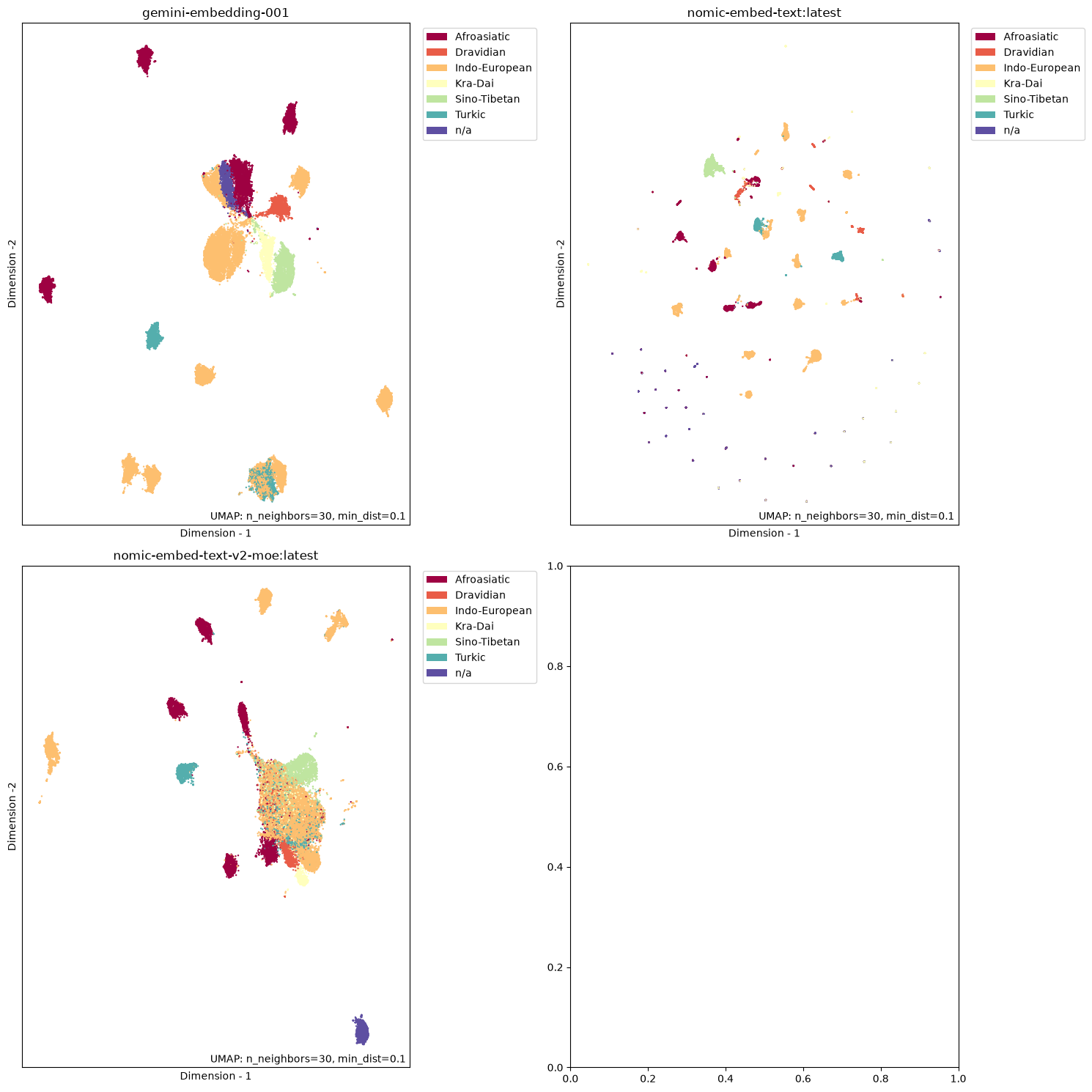
Visual inspection of the projections shows distinct clusters, each comprised primarily of a single language group, for all three vectorisers. The colours correspond to the actual language group of the text.
tar_encoder = {}for c in collections: tar_encoder[c] = LabelEncoder() language_values = samples[c].language_group.fillna("n/a")# detect_language (used later for heur_lang) can return '' when no candidate# clears MIN_CONFIDENCE, even though no ground-truth row is ever ''. Include# it as a known class up front so transform() never hits an unseen label. tar_encoder[c].fit(pd.concat([language_values, pd.Series([''])], ignore_index=True)) target = tar_encoder[c].transform(language_values) samples[c]['target_idx'] = pd.Series(target)
Code
knn_clf = {}for c in collections: knn_clf[c] = fit_knn_classifier(dim_red[c],samples[c].loc[train_flag[c],'target_idx'],**knn_params)
Code
train_pred = {}test_pred = {}for c in collections: tr_f = train_flag[c] te_f = test_flag[c] train_vec = vectors[c][tr_f, :] tr_proj, tr_missing = project(umap_model[c], train_vec, train_vec) te_proj, te_missing = project(umap_model[c], vectors[c][te_f, :], train_vec)print(f"{c}: {tr_missing} train and {te_missing} test points had no UMAP ""neighbours and were placed at their nearest training point") train_pred[c] = knn_clf[c].predict(tr_proj) test_pred[c] = knn_clf[c].predict(te_proj) samples[c]['knn_predictions'] = np.nan samples[c].loc[tr_f, 'knn_predictions'] = train_pred[c] samples[c].loc[te_f, 'knn_predictions'] = test_pred[c] samples[c]['knn_predictions'] = samples[c]['knn_predictions'].astype(int) samples[c].loc[tr_f,'Train/Test'] ="Train" samples[c].loc[te_f, 'Train/Test'] ="Test"
Sun Nov  1 21:22:10 2026 Building hub-based search tree
Sun Nov  1 21:22:17 2026 Forward diversification reduced edges from 1266540 to 421183
Sun Nov  1 21:22:19 2026 Reverse diversification reduced edges from 421183 to 421183
Sun Nov  1 21:22:21 2026 Degree pruning reduced edges from 483844 to 483844
Sun Nov  1 21:22:21 2026 Resorting data and graph based on tree order
Sun Nov  1 21:22:22 2026 Building and compiling search function
    completed  0  /  100 epochs
    completed  10  /  100 epochs
    completed  20  /  100 epochs
    completed  30  /  100 epochs
    completed  40  /  100 epochs
    completed  50  /  100 epochs
    completed  60  /  100 epochs
    completed  70  /  100 epochs
    completed  80  /  100 epochs
    completed  90  /  100 epochs
gemini-embedding-001: 0 train and 0 test points had no UMAP neighbours and were placed at their nearest training point
Sun Nov  1 21:22:32 2026 Building hub-based search tree
Sun Nov  1 21:22:32 2026 Forward diversification reduced edges from 1266540 to 424702
Sun Nov  1 21:22:32 2026 Reverse diversification reduced edges from 424702 to 424702
Sun Nov  1 21:22:32 2026 Degree pruning reduced edges from 527820 to 527784
Sun Nov  1 21:22:32 2026 Resorting data and graph based on tree order
Sun Nov  1 21:22:32 2026 Building and compiling search function
    completed  0  /  100 epochs
    completed  10  /  100 epochs
    completed  20  /  100 epochs
    completed  30  /  100 epochs
    completed  40  /  100 epochs
    completed  50  /  100 epochs
    completed  60  /  100 epochs
    completed  70  /  100 epochs
    completed  80  /  100 epochs
    completed  90  /  100 epochs
nomic-embed-text:latest: 0 train and 120 test points had no UMAP neighbours and were placed at their nearest training point
Sun Nov  1 21:22:43 2026 Building hub-based search tree
Sun Nov  1 21:22:43 2026 Forward diversification reduced edges from 1266540 to 446401
Sun Nov  1 21:22:43 2026 Reverse diversification reduced edges from 446401 to 446401
Sun Nov  1 21:22:43 2026 Degree pruning reduced edges from 538314 to 538052
Sun Nov  1 21:22:43 2026 Resorting data and graph based on tree order
Sun Nov  1 21:22:43 2026 Building and compiling search function
    completed  0  /  100 epochs
    completed  10  /  100 epochs
    completed  20  /  100 epochs
    completed  30  /  100 epochs
    completed  40  /  100 epochs
    completed  50  /  100 epochs
    completed  60  /  100 epochs
    completed  70  /  100 epochs
    completed  80  /  100 epochs
    completed  90  /  100 epochs
nomic-embed-text-v2-moe:latest: 0 train and 0 test points had no UMAP neighbours and were placed at their nearest training point
4.0 Results
4.1 Performance of Word Embeddings in Proto-Language Identification
The performance of the umap+knn-classification approach on all three collections was assessed on the test set using Normalised Mutual Information, Recall and Precision. gemini-embedding-001 performed best on all three metrics, followed closely by nomic-embed-text:latest, with nomic-embed-text-v2-moe:latest trailing on mutual information and recall. The strong performance of nomic-embed-text:latest is surprising, particularly because it was developed primarily for English (en).
In a separate exploration (here), I showed how gemini-embedding-001 performs better at retrieving translations that share the same verse both in the same language and cross-language and therefore is better suited for an application that requires looking beyond the characters in the text.
Normalised Mutual Information - gemini-embedding-001 (0.90) and nomic-embed-text:latest (0.88), which only supports English, produced vectors that are similarly informative about the language group of the text, well ahead of nomic-embed-text-v2-moe:latest (0.72).
Recall - gemini-embedding-001 achieved the highest recall (0.95), followed by nomic-embed-text:latest (0.91) and nomic-embed-text-v2-moe:latest (0.79).
Precision - gemini-embedding-001 achieved the best precision (0.96), followed by nomic-embed-text-v2-moe:latest (0.92) and nomic-embed-text:latest (0.89). nomic-embed-text-v2-moe:latest is therefore conservative: when it assigns a language group it is usually right, but it misses more records than the other two models.
- A breakdown of the results for each of the embedding models is provided in the tables below:
Code
def per_class_scores(df, encoder, tar_col="target_idx", pred_col="knn_predictions"):""" per-class recall and precision computed over the whole of df. Scoring within a single language group would leave only one true class, so precision would collapse to 1/(number of distinct classes predicted). """ labels = np.arange(len(encoder.classes_)) names = encoder.classes_# '' is only in the encoder so heuristic labels can be transformed; it is# never a true or predicted class here. keep = names !='' rec = recall_score(df[tar_col], df[pred_col], labels=labels, average=None, zero_division=np.nan) prec = precision_score(df[tar_col], df[pred_col], labels=labels, average=None, zero_division=np.nan) index = pd.Index(names[keep], name="language_group")return pd.Series(rec[keep], index=index), pd.Series(prec[keep], index=index)agg_recall = []agg_precision = []for c in collections: test = samples[c][samples[c]['Train/Test'].eq("Test")] rk, pk = per_class_scores(test, tar_encoder[c]) agg_recall.append(rk.rename(f"UMAP+KNN - {c} - Recall")) agg_precision.append(pk.rename(f"UMAP+KNN - {c} - Precision"))
Multilingual support is not a predictor of performance: gemini-embedding-001 performed best, but nomic-embed-text:latest, which only supports English, came close, while nomic-embed-text-v2-moe:latest, which supports almost every language in the study, performed worst on recall and MI.
The weak spots are the small language groups: performance was weakest for language groups represented by only one or two languages: Kra-Dai (Thai) for nomic-embed-text:latest, and Turkic for nomic-embed-text-v2-moe:latest and gemini-embedding-001. Indo-European, which covers 11 of the 20 languages and roughly half of the sample, scored consistently high, which suggests that the majority group absorbs neighbouring points from smaller groups.